4 min read · Updated
What Is Moissanite? Is It a Real Diamond?
Short answer
Moissanite is silicon carbide grown in a lab, a gemstone that resembles diamond without being one. With a Mohs hardness of 9.25, it outlasts every other diamond simulant for scratch resistance, and its fire is more than double diamond's. It is a genuine stone with its own chemistry; it simply isn't diamond.
Where does moissanite come from?
In 1893 the French chemist Henri Moissan found tiny, very hard crystals in rock from the meteor crater near Canyon Diablo, Arizona. He first took them for diamond; in 1904 he identified them as silicon carbide, and the mineral was named moissanite after him. Natural moissanite is so rare and so small that it plays no part in jewelry.
The moissanite sold today is grown in a lab. A company then called C3 Inc. developed near-colorless gem crystals in the 1990s, and GIA's journal Gems & Gemology described them as a new diamond substitute in its Winter 1997 issue. Jewelry moissanite went on sale in 1998.
Is moissanite a real diamond?
No. Diamond is carbon; moissanite is silicon and carbon. They are different minerals with different crystal structures, densities and optical properties. Calling moissanite a “moissanite diamond”, as some listings do, is misleading. The fair description is that moissanite is a real gemstone that serves as a diamond alternative.
Lab-grown doesn't mean fake. A lab-grown moissanite is real silicon carbide, just as a lab-grown diamond is real diamond. What makes a description honest is naming the material. We describe our stones as moissanite, and never as diamond.
How hard and how bright is it?
GIA puts moissanite at 9.25 on the Mohs scale, below diamond's 10 and above sapphire's 9, and calls it the hardest diamond simulant. Its refractive index is about 2.65–2.69 and its dispersion about 0.104, more than twice diamond's 0.044, which is why moissanite shows so many rainbow flashes in sunlight. It is also doubly refractive: look through a larger stone at an angle with a loupe and facet edges appear doubled. On small bezel stones that doubling is hard to see.
What is VVS moissanite?
VVS is borrowed from GIA's diamond clarity scale, where it stands for “very, very slightly included”: inclusions so small that a trained grader struggles to see them at 10× magnification. Moissanite sellers use the same letters for their own grading. Because lab-grown moissanite is usually very clean, most stones on the market are sold as VVS. Treat it as a description of a clean stone rather than a premium tier; it doesn't mean the stone is diamond.
What is a GRA certificate?
GRA is a grading report widely issued with moissanite, listing details such as size, color and clarity. It is not GIA, which grades diamonds and colored gems, and it isn't an independent laboratory certificate in the way a GIA diamond report is. Our moissanite is supplied as GRA-certified. We tell you that because it's what the trade uses, not because it makes moissanite anything other than moissanite.
Does moissanite get cloudy or tarnish?
Moissanite won't tarnish, fade or turn cloudy by itself: it is chemically stable and hard enough to hold its polish. A dull-looking stone nearly always has a film of skin oil, soap or lotion on its underside, where light enters. Lukewarm water, a little gentle dish soap and a soft-bristled toothbrush clear it. What can change color with time is the metal finish around the stone.
Is moissanite good for a watch?
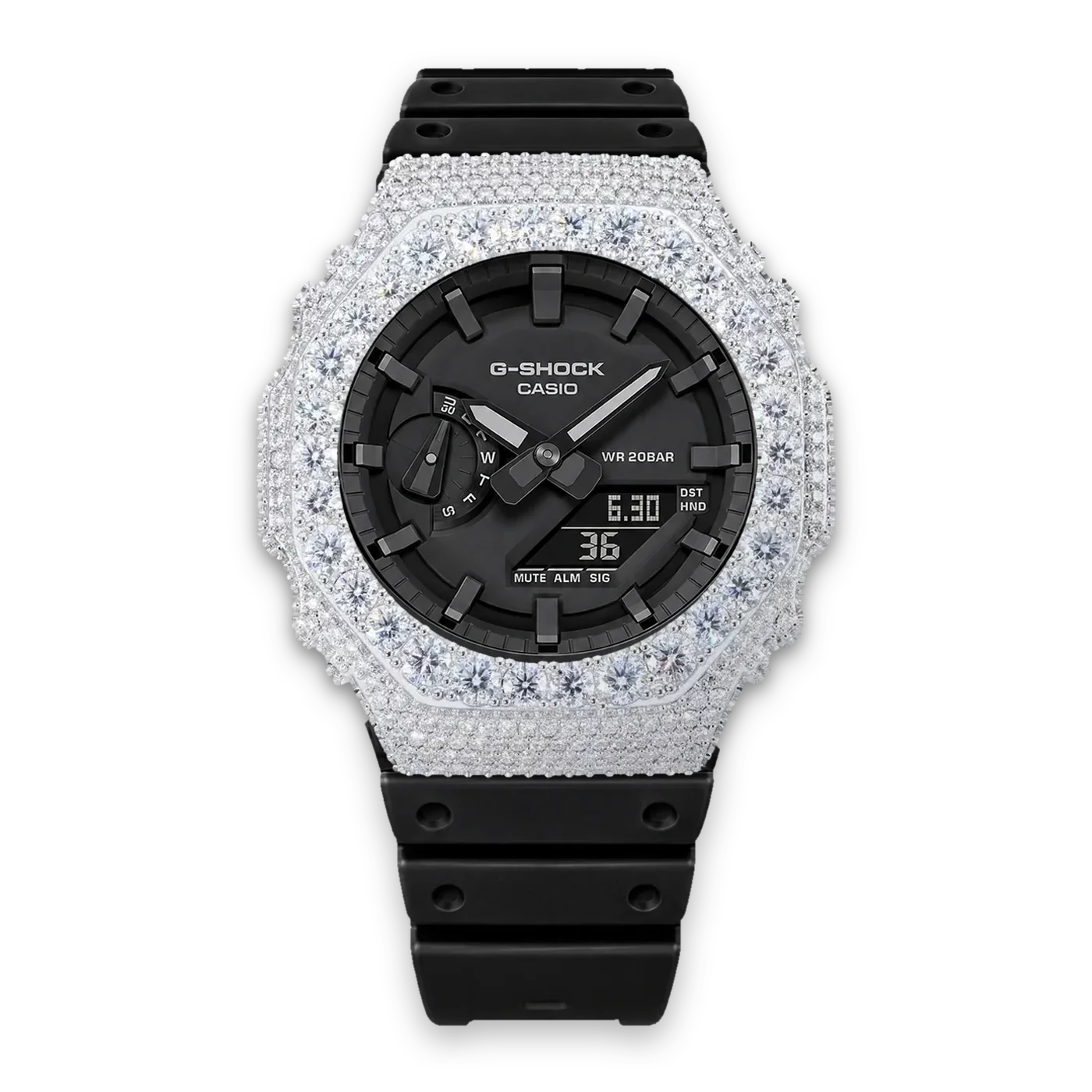
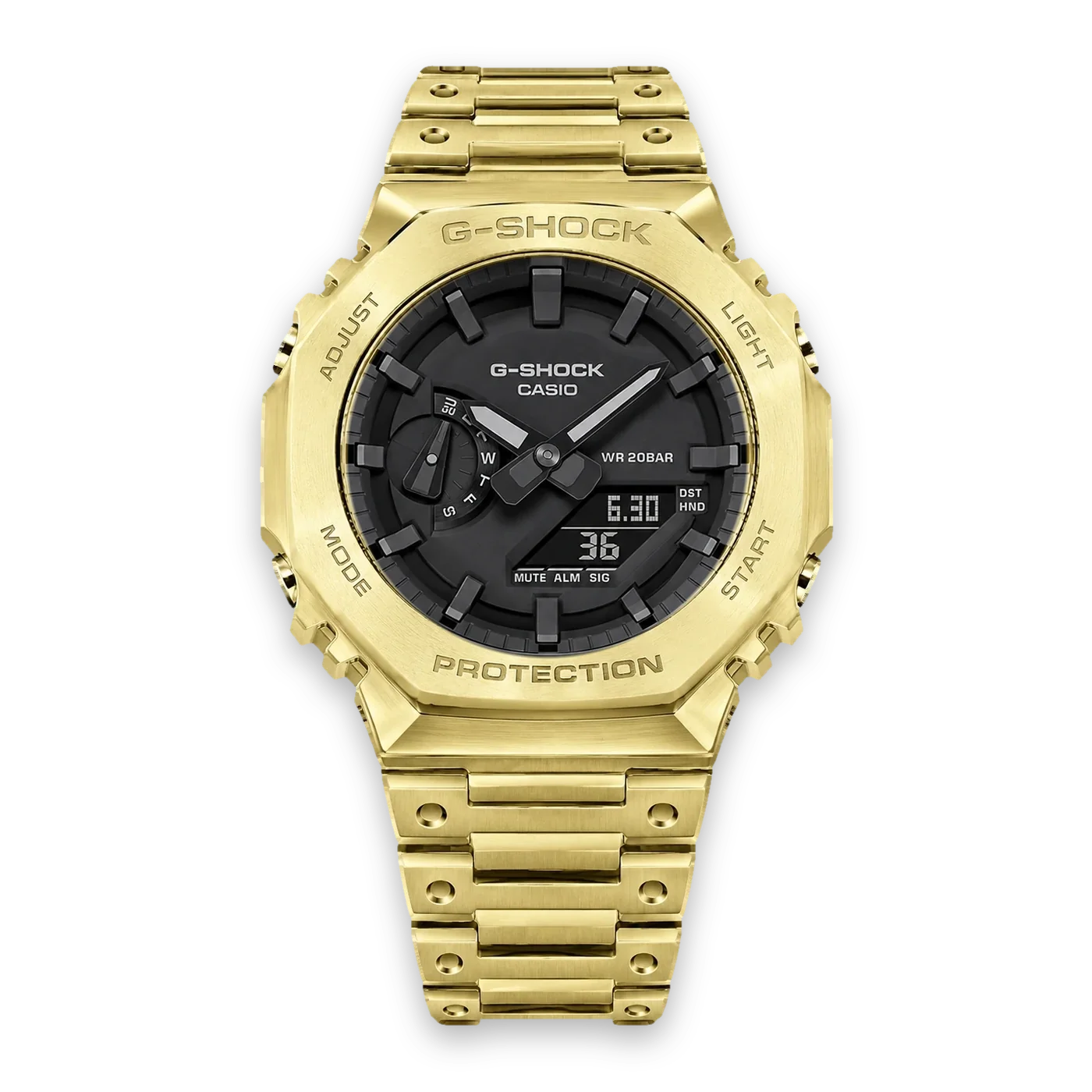
It is close to ideal. A watch bezel takes more knocks than almost any other piece of jewelry, so hardness matters more than it would on earrings. Moissanite's hardness keeps facet edges sharp, its fire suits the small stones of a pavé bezel, and it costs a fraction of diamond. On our G-SHOCK builds, choosing moissanite over CZ adds $50. Over years of daily wear, that hardness is what keeps a pavé bezel looking new, while CZ facets slowly round off and lose their snap.
What color is moissanite?
GIA's 1997 study described the first jewelry moissanite as near-colorless. Today most moissanite sold today is graded colorless or near-colorless on scales modelled on diamond's D-to-Z grades. In strong daylight, its high dispersion adds flashes of color that some people read as a slight rainbow cast. Colored moissanite is also made on purpose, which is how rainbow moissanite bezels get their red, blue and green baguettes.
How do you tell moissanite from diamond?
A thermal diamond tester can't, because moissanite conducts heat much like diamond. A multi-tester with an electrical check can, and so can a jeweler's loupe: look through the side of a larger stone and the back facet edges appear doubled in moissanite, never in diamond. A gem lab can always tell. Our guide to diamond testers covers this in detail.
FAQ
Is moissanite fake?
No. Moissanite is a genuine gemstone, silicon carbide made in a lab. It only becomes a fake when someone passes it off as diamond.
Is moissanite worth it?
If you want the diamond look with high durability at a fraction of the price, yes. If you need diamond for resale value, no.
Will moissanite fool a diamond tester?
Many basic thermal testers read it as diamond. Testers that also check electrical conductivity tell them apart.
Is moissanite natural?
Natural moissanite exists but only as tiny crystals. All jewelry moissanite is lab-grown.
Is moissanite cubic zirconia?
No. Moissanite is silicon carbide; cubic zirconia is zirconium oxide. Moissanite is harder and shows more fire.