4 min read · Updated
Moissanite vs CZ on a Watch (and Where Diamond Fits)
Short answer
Moissanite beats CZ on a watch: it is harder (9.25 against 8.5 on the Mohs scale), shows more than twice diamond's fire, and keeps its polish for years, while CZ scratches and clouds sooner but costs less. Diamond tops the hardness scale at 10 and costs many times more than either. On a bezel that gets knocked every day, moissanite is the balanced pick.
Moissanite vs CZ: which is better on a watch?
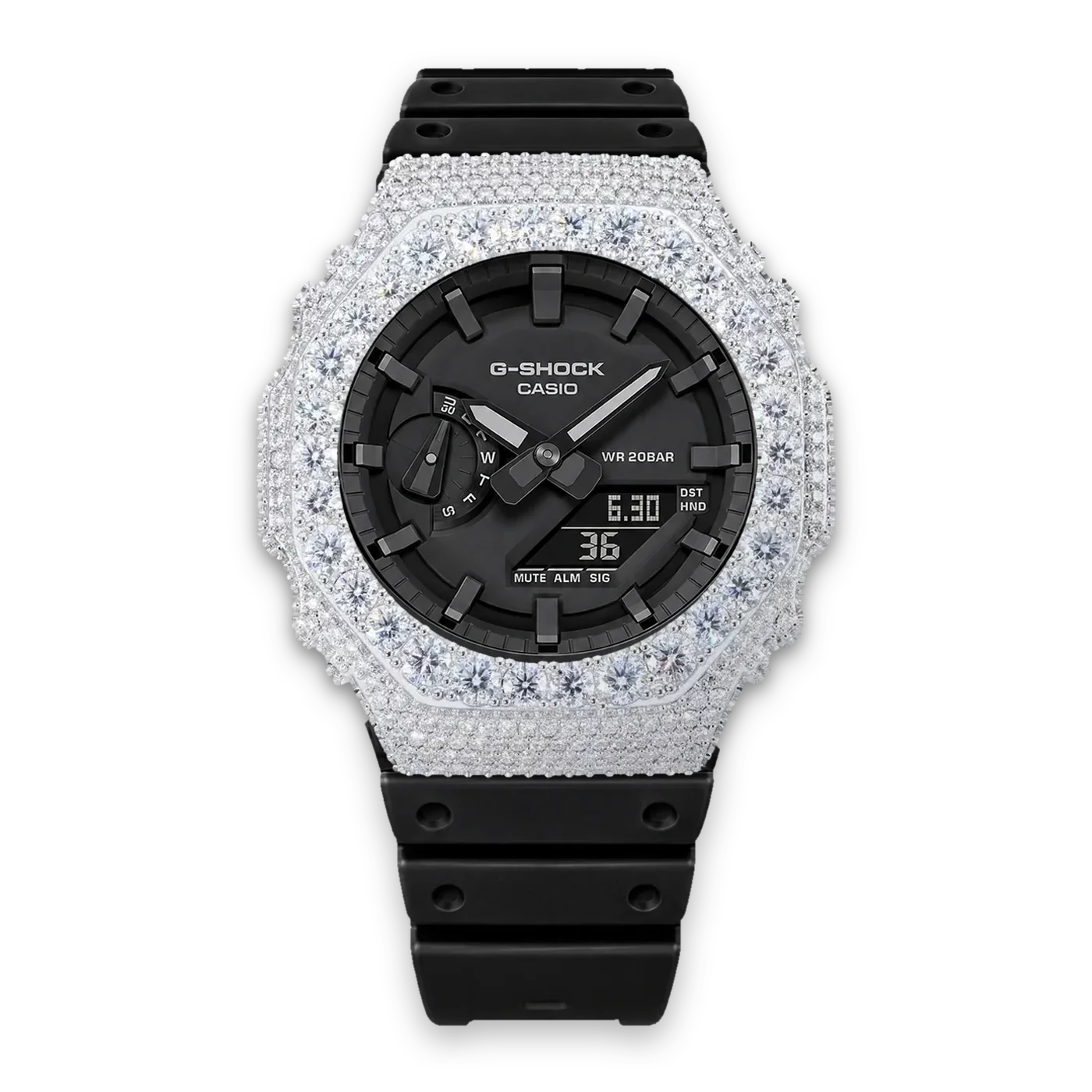
On a watch, moissanite is the better stone and CZ the better bargain. Moissanite's extra hardness keeps facet edges crisp after years of desk knocks, it throws more colored fire, and it doesn't cloud. CZ gives the same silhouette for less money, which makes sense on a watch you'll wear on weekends. On our builds the gap is $50 on a standard bezel and $110 on a rainbow one. Diamond sits outside that choice: harder still, less colorful in its sparkle than moissanite, and many times the price. The rest of this guide shows the numbers behind that verdict; for the bezel-only version, see our CZ vs moissanite bezel guide.
What are the three stones made of?
Diamond is crystallized carbon, formed deep in the earth or grown in a lab. Moissanite is silicon carbide. It was first found as tiny crystals by the chemist Henri Moissan in 1893, in rock from the Canyon Diablo meteorite site in Arizona, and natural crystals are far too small and rare for jewelry, so every moissanite you can buy is lab-grown. Near-colorless gem moissanite came to market in the late 1990s; GIA's journal Gems & Gemology examined the first jewelry-grade stones in 1997.
Cubic zirconia is zirconium oxide, grown as a cubic crystal with a stabilizer such as yttrium oxide. It doesn't occur in nature in usable sizes; commercial production began in 1976. All three are real crystals. Only one is diamond.
Which is hardest, and why does it matter?
Hardness on the Mohs scale measures scratch resistance. GIA puts diamond at 10, moissanite at 9.25 and CZ at 8.5, and describes moissanite as the hardest of all diamond simulants. Dust contains quartz at about 7, so anything above that resists everyday scratching; the higher you go, the longer the facet edges stay crisp.
On a ring, the difference between 9.25 and 8.5 shows up over years. On a watch bezel it shows up faster, because a bezel is the part that hits door frames, desks and car doors. That is the main reason we recommend moissanite for a G-SHOCK you'll wear every day.
- Diamond: Mohs 10, the reference point for hardness.
- Moissanite: Mohs 9.25, hardest of the simulants (GIA).
- Cubic zirconia: Mohs 8.5; scratches more easily than diamond (GIA).
Which sparkles more?
Sparkle is really three things. Brilliance is white light returned to your eye, which depends mostly on refractive index. Fire is the flashes of rainbow color, which depends on dispersion. Scintillation is the on-off twinkle as the stone or the light moves.
Moissanite has the highest numbers of the three: a refractive index of about 2.65–2.69 and dispersion of 0.104, figures published by GIA's Nassau and colleagues in 1997. Diamond's refractive index is about 2.42 with dispersion of 0.044. Cubic zirconia sits at about 2.15–2.18 and 0.058–0.066. In plain terms, moissanite throws the most color, diamond the crispest white, and CZ a little more color than diamond but less brightness. GIA notes that large moissanites can look almost too fiery; on the small stones of a watch bezel, that fire is exactly what makes it catch the light.
Do they look different to the eye?
At the size of bezel stones, most people can't tell moissanite from diamond at arm's length; the giveaway is more color in sunlight. Up close with a loupe, moissanite is doubly refractive, so facet edges can look doubled when you look through the stone at an angle; diamond and CZ are singly refractive. Over time CZ is the easiest to spot: GIA notes it scratches more easily and that colorless CZ may yellow, and a worn CZ looks softer at the edges.
How do they hold up over years?
Diamond and moissanite keep their polish for decades of normal wear. CZ gradually picks up fine scratches and abrasion on facet edges, which makes it look a little cloudy. None of the three tarnish; what dulls any of them is a film of skin oil, soap and lotion, which washes off with warm water, mild soap and a soft brush.
Heat and chemicals are rarely an issue on a watch. Moissanite is very heat tolerant; CZ is stable in everyday use. The metal setting, not the stone, usually decides how a piece ages.
How do they compare on price?
Diamond costs far more than either, and a bezel needs hundreds of stones, which is why fully set diamond G-SHOCK bezels run into the thousands. Moissanite costs more than CZ because it is harder to grow and cut. On our builds the gap is $50: a CZ iced bezel adds $100 to the watch and a moissanite one adds $150 ($110 and $220 for rainbow).
Which should you choose for a watch?
If budget is the main concern and the watch will be worn sometimes, CZ gives the full iced look for less. If you'll wear it every day, want the most sparkle and want it to look the same in five years, moissanite is worth the difference. If you need diamond specifically, for resale or because it matters to you, buy diamond from a jeweler who grades it, and expect to pay many times more. We sell CZ and moissanite only, and we never describe either as diamond.
FAQ
Is moissanite better than diamond?
It has more fire and costs far less; diamond is harder and keeps a whiter brilliance. Which is better depends on what you value.
Which lasts longer, moissanite or cubic zirconia?
For durability and sparkle, yes: it is harder (9.25 vs 8.5) and brighter. CZ costs less.
Can anyone tell moissanite and diamond apart?
Rarely by eye at the small sizes used on a bezel. Moissanite is doubly refractive, so a loupe reveals doubled facet edges, and a tester that checks electrical conductivity separates the two.
Does cubic zirconia turn cloudy?
It can look cloudy as fine scratches build up on the facets and as dirt collects. Cleaning helps; scratches don't polish out at home.